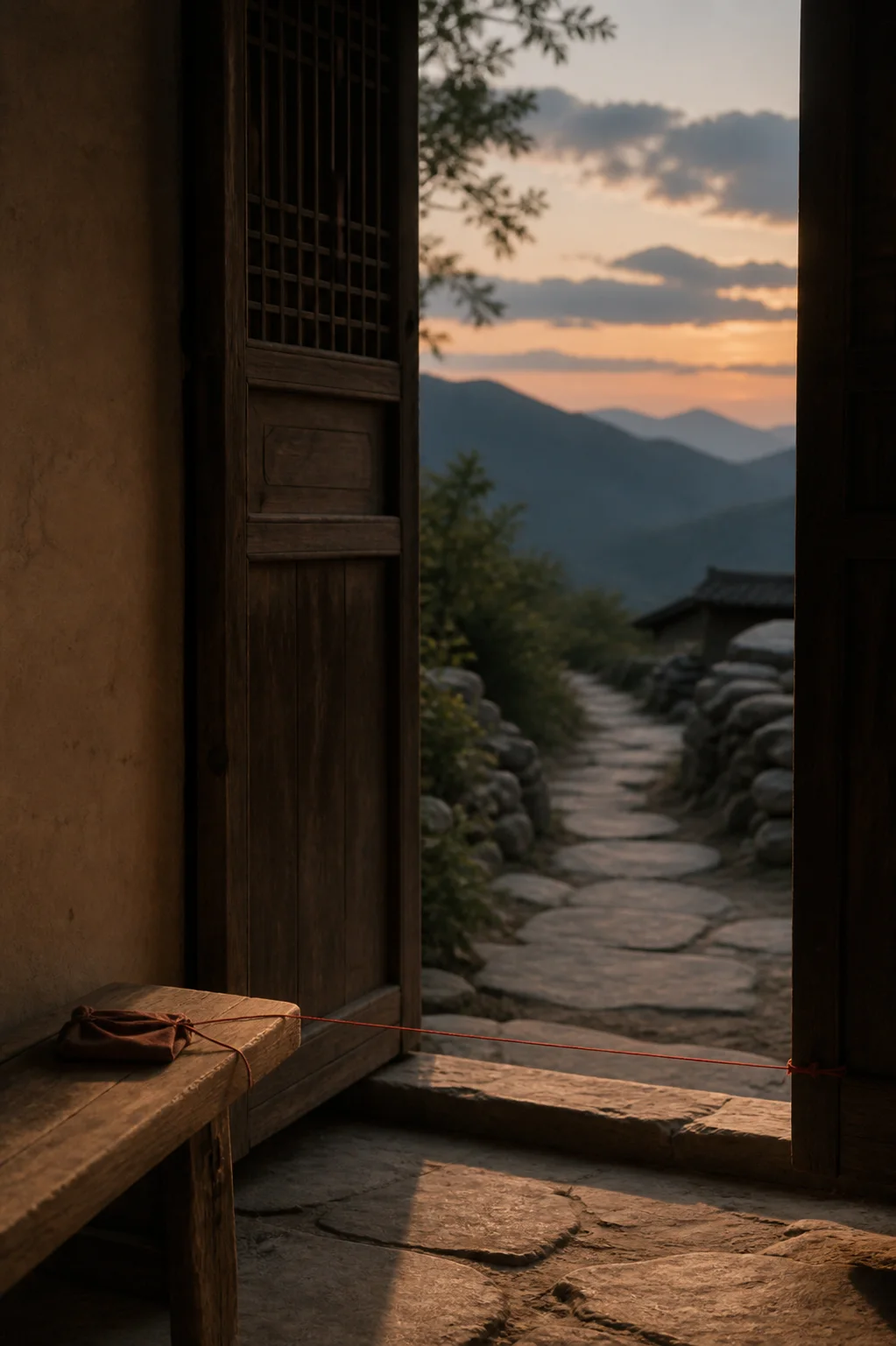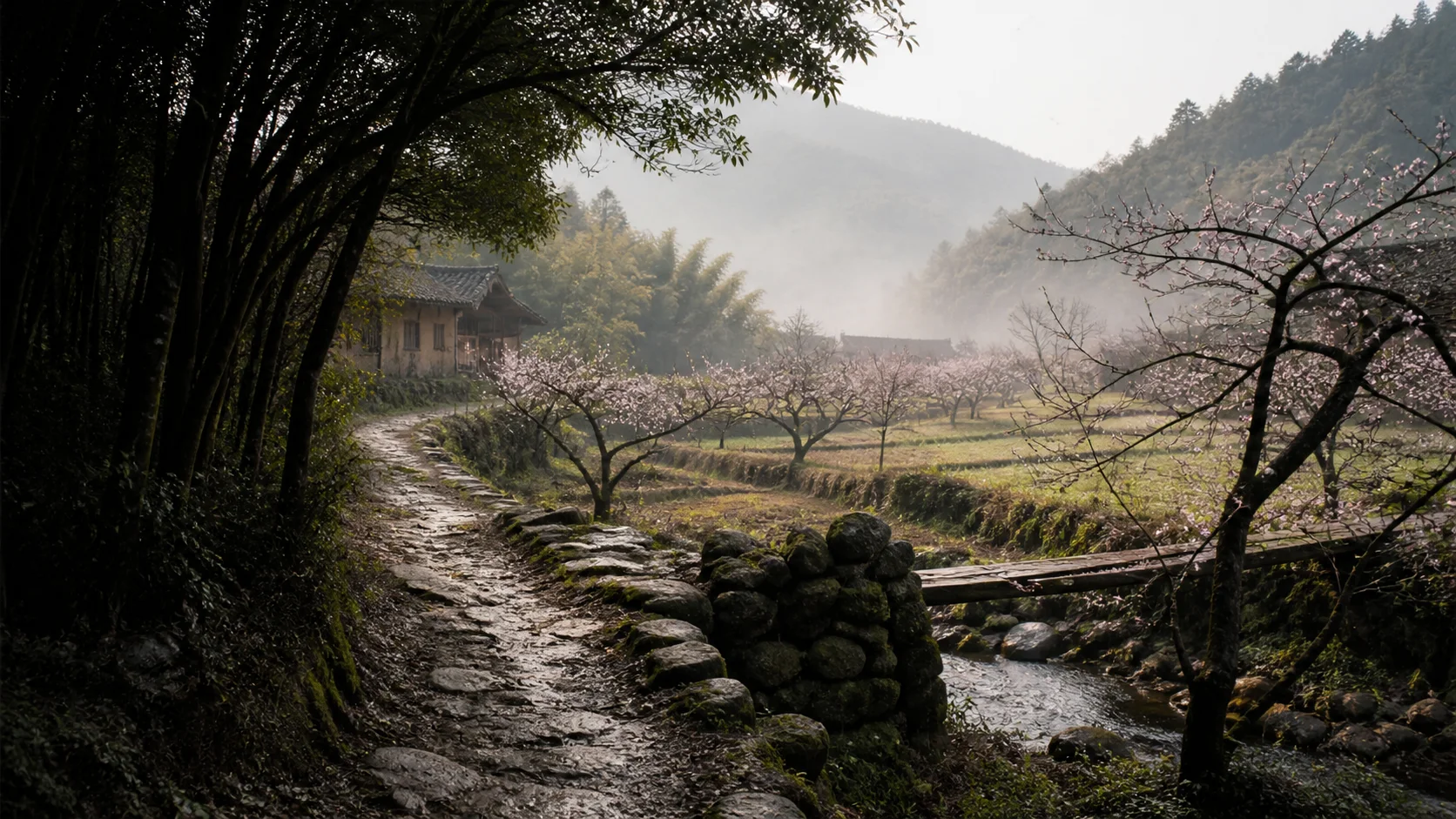
THE THRESHOLD IN THE STORY
The Peach Blossom Spring begins with a passage, not a promise.
In Tao Yuanming’s short account, a fisherman follows a stream until peach trees gather on both banks. He finds a narrow opening, enters a hidden valley, and meets people who have lived there beyond the reach of the ordinary world. The scene is compact, but its emotional effect is enormous: a familiar landscape opens into an entirely different arrangement of time, memory, and belonging.
It is easy to turn that opening into a fantasy of disappearance. The story is more interesting when the threshold remains a question. What does a place protect? Who gets to enter? What has been left outside? A doorway can offer relief, but it also asks us to notice the conditions that make relief possible. The valley feels peaceful because its people have made a life with rules, work, kinship, and shared memory—not because beauty has removed every difficulty.
“The hidden valley is not only somewhere else. It is a question about the conditions of belonging.”
A REFUGE NEEDS A LIFE
A place does not become meaningful because it is untouched; it becomes meaningful because people tend it.
The most seductive version of a refuge has no maintenance. The rooms are already calm, the food is already ready, the light arrives at the exact right hour, and no one needs to negotiate the ordinary friction of living together. Real places are different. A garden needs watering. A table needs clearing. A community needs boundaries, repair, memory, and a way to decide what happens next.
That difference gives the story a useful modern edge. When you imagine a better life, do not only picture its atmosphere. Notice its infrastructure. What would your day require? Which conversations would become easier? What would need to be protected from interruption? A livable future is not a mood board. It is a set of repeatable choices that makes enough room for attention to survive.
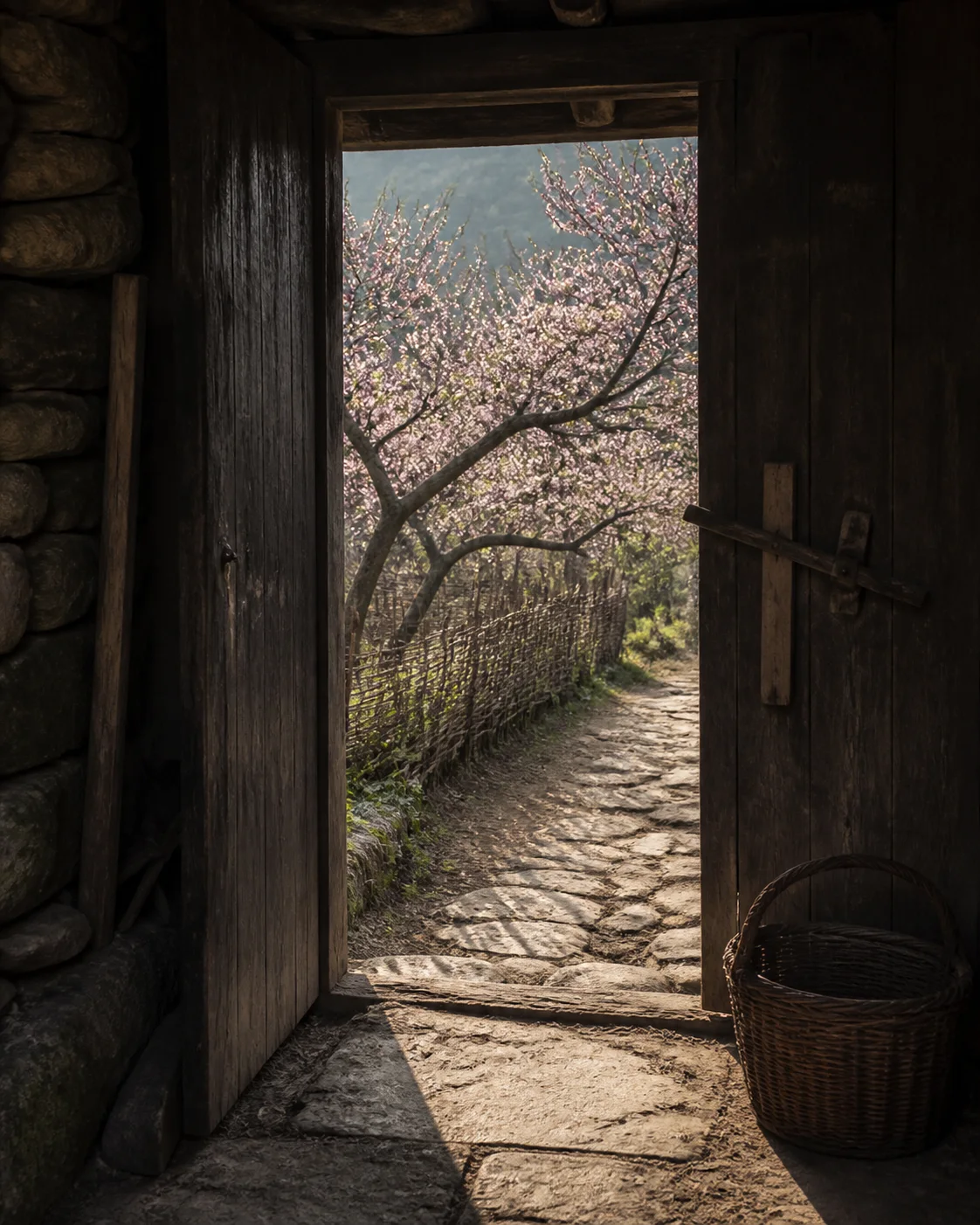
THE COST OF FINDING IT
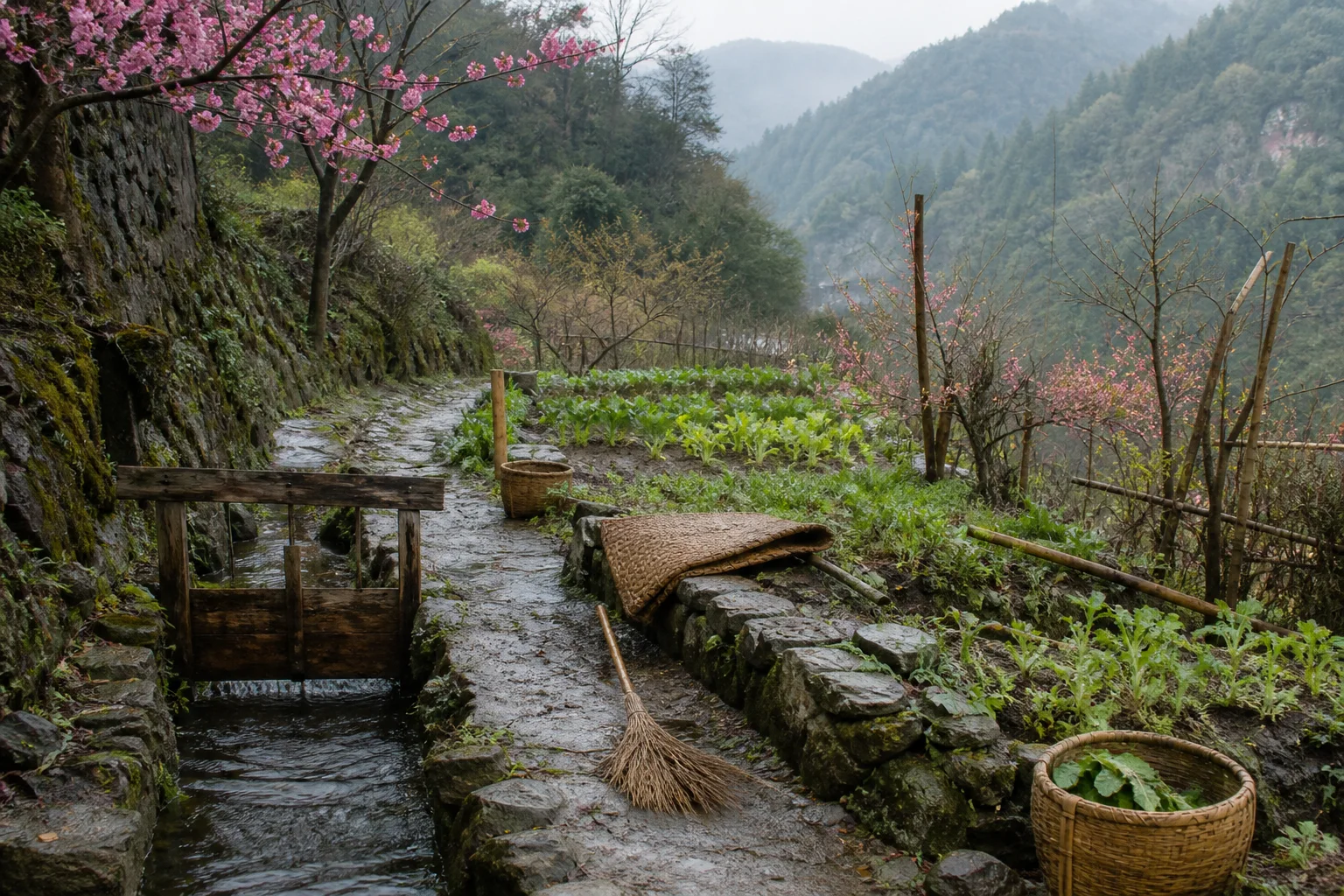
The fisherman can find the path once. He cannot simply turn a private discovery into public access.
After leaving, the fisherman tries to retrace the route and mark it for others. The passage disappears. Later visitors cannot recover what he found. The story’s ending refuses the easy logic of discovery: a hidden place is not automatically improved by being mapped, advertised, or made available to everyone who wants it. Some forms of care depend on scale, consent, and the right to remain partially unseen.
That does not mean every beautiful thing should be hidden. It means access should not be confused with entitlement. In a personal life, this can look like keeping one practice private, protecting a friendship from constant explanation, or declining to turn a restorative place into content. Ask what sharing would make possible, and what it might flatten. The most respectful invitation leaves the other person free to say no.
MAKE ONE CORNER RETURNABLE
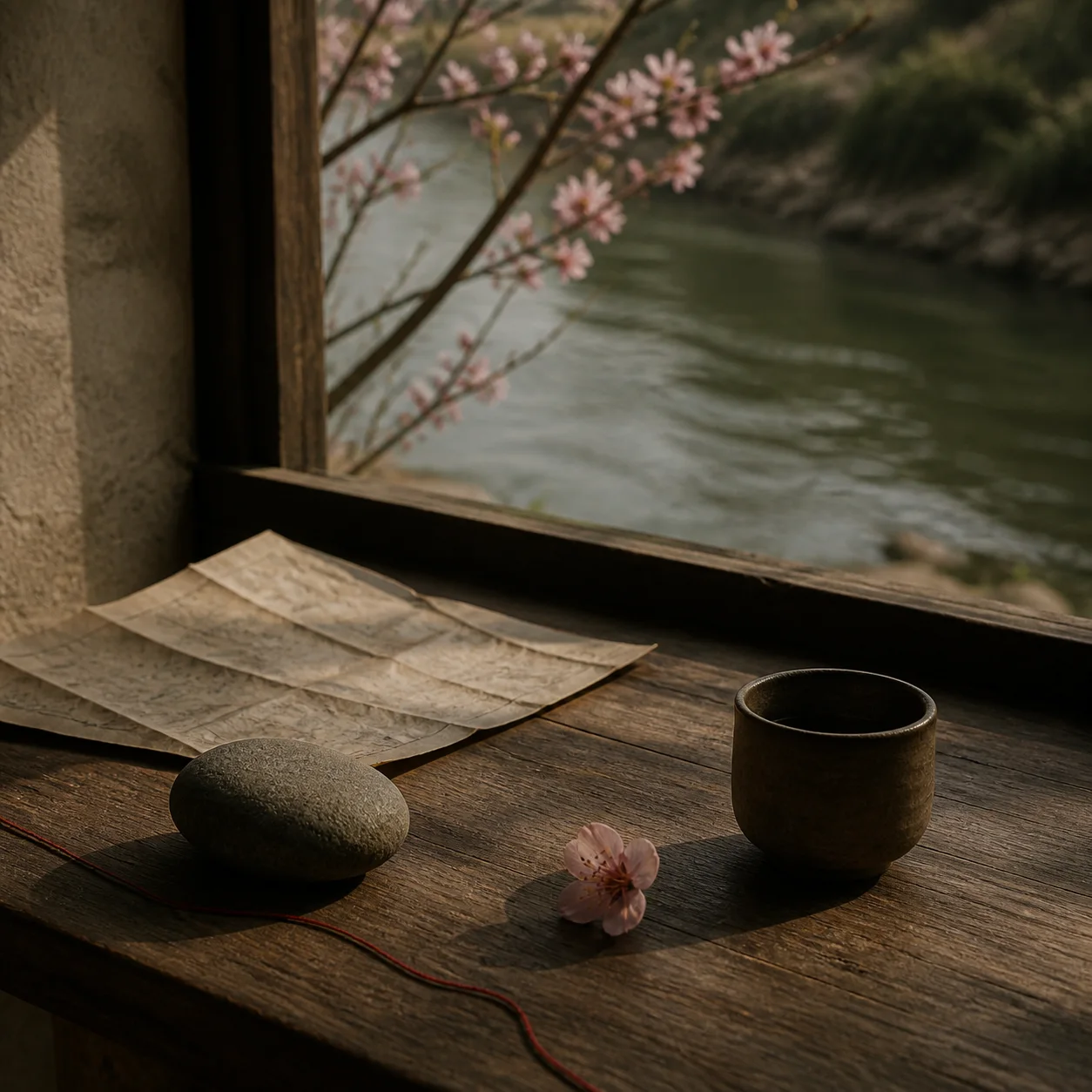
You do not need to build a valley. Begin by making one small part of the day easier to return to.
Choose one threshold you cross often: the first ten minutes after work, the place where you put your keys, the chair where you read, or the walk between a station and home. Notice what currently makes that transition feel hurried or hostile. Then change one physical fact. Clear a surface. Move an object into reach. Put a glass of water where you will see it. Let a quieter action have a defined beginning and end.
The point is not to manufacture a perfect sanctuary. It is to make one promise to the future version of yourself that can be kept without performance. For seven days, ask three questions: What helped me arrive? What made me leave myself again? What would make tomorrow’s return a little kinder? Write the answers plainly. A useful symbol should open observation, not close it with a verdict.
BEAUTY WITHOUT ESCAPE
The best reading of the Peach Blossom Spring does not ask you to abandon the world. It asks you to see its arrangements more clearly.
The story has been revisited through painting, poetry, gardens, and interiors because its central image is so flexible: a path, a grove, a wall, an opening, a room beyond the room. Yet the image keeps its force when it stays connected to human scale. The mountain is not decoration alone. It frames distance. The water is not a special effect. It gives the journey direction. The grove is not a promise of innocence. It is the beginning of a social imagination.
Use the image in the same way. Let it help you name the quality you want to protect—privacy, welcome, slowness, clarity, or a sense of enoughness—but do not ask it to solve what needs practical support. Meaning becomes durable when it can meet a real schedule, a real room, and the limits of a real body. Beauty is not an exit. It is one way of learning what deserves care.
CARRY THE RETURN
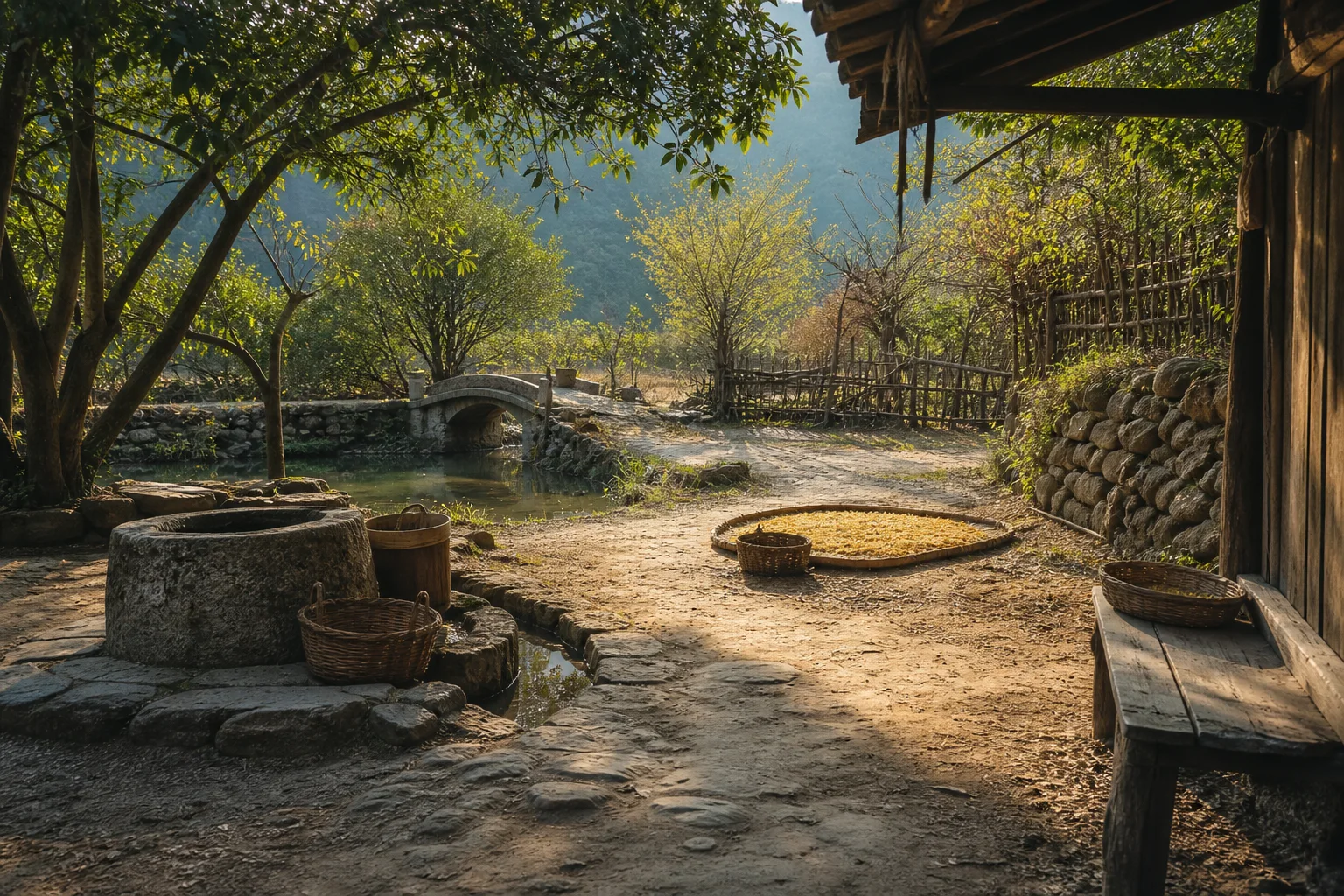
A meaningful object can mark the place you have chosen to tend.
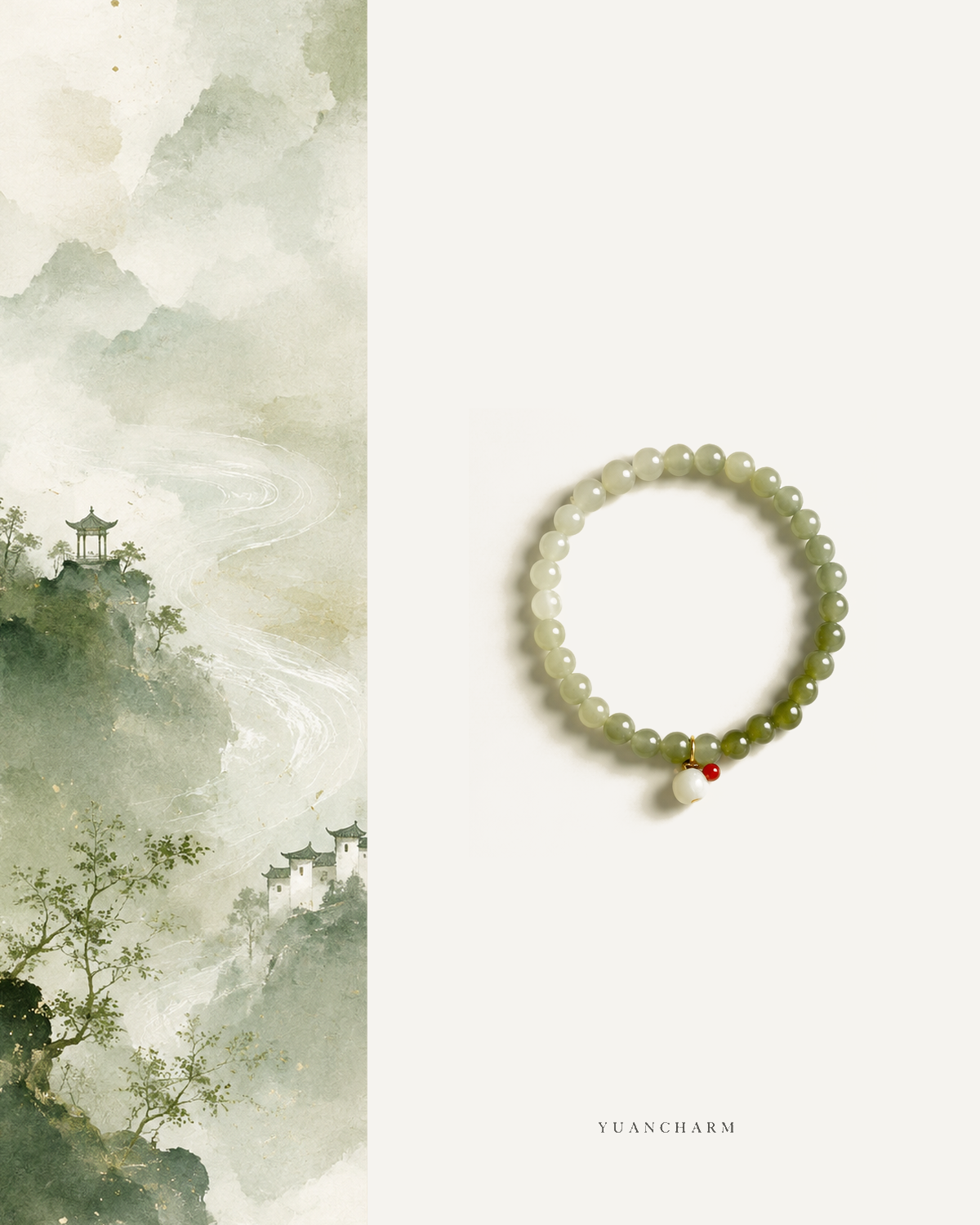
Jade Afterglow carries this idea in a restrained visual language: balanced green jade, an ivory charm, a small red accent, and the calm contrast of a spring mountain at dusk. It is not a miniature Peach Blossom Spring, and it cannot make a difficult place gentle on its own. Its value is simpler. It gives a chosen line a material rhythm that can meet an ordinary hand, a commute, a desk, or a door being opened at the end of the day.
If you choose an object for this reason, give it one honest job. Let it remind you to make the next corner more inhabitable, to protect a boundary, or to return to a conversation with less haste. The symbol should remain porous enough for your life to change it. A place worth finding is also a place worth tending after the first feeling of wonder has passed.