BEFORE THE DAY OPENS
A ritual is a decision made easier to repeat.
Most mornings do not need another demand. They need one small moment in which the day is not yet asking for an answer. A bracelet can hold that moment because it is close, tactile, and visible without requiring a screen.
The act can be as simple as choosing a bracelet from a tray, noticing its weight, and deciding what you want it to remind you of. No incense, prediction, or performance is required. The point is not to make the morning more mysterious. It is to make one choice feel deliberate.
“The most useful ritual is the one that still works on a busy day.”
THREE MINUTES
A simple sequence for wearing with intention.
First, name the weather inside the day. Are you moving quickly, protecting a quiet hour, meeting someone new, or trying to finish something that has been waiting? The answer does not need to be profound. It only needs to be true enough to orient you.
Second, choose one carry line. It might be ‘keep the boundary’, ‘leave space’, ‘begin without rushing’, or ‘stay close to what matters’. Third, put the bracelet on and let the sentence become physical. You are not asking the object to create the result. You are giving yourself a place to remember the choice.
THE PRACTICAL WRIST
Comfort is not a compromise to the ritual.
Some traditions give each wrist a symbolic role. You can borrow that language if it helps, but the best wrist is the one that lets the bracelet live naturally in your day. If you write, cook, or work with one hand, try the other. If you wear a watch, give both objects enough space to be seen and to move without friction.
The same goes for fit. A bracelet should feel secure without making you monitor it every minute. Check the sizing information, measure the wrist as instructed, and remember that the piece will be worn by a moving body rather than displayed on a still surface.
STYLE AS A FORM OF ATTENTION
Let the piece belong to your clothes, not replace them.
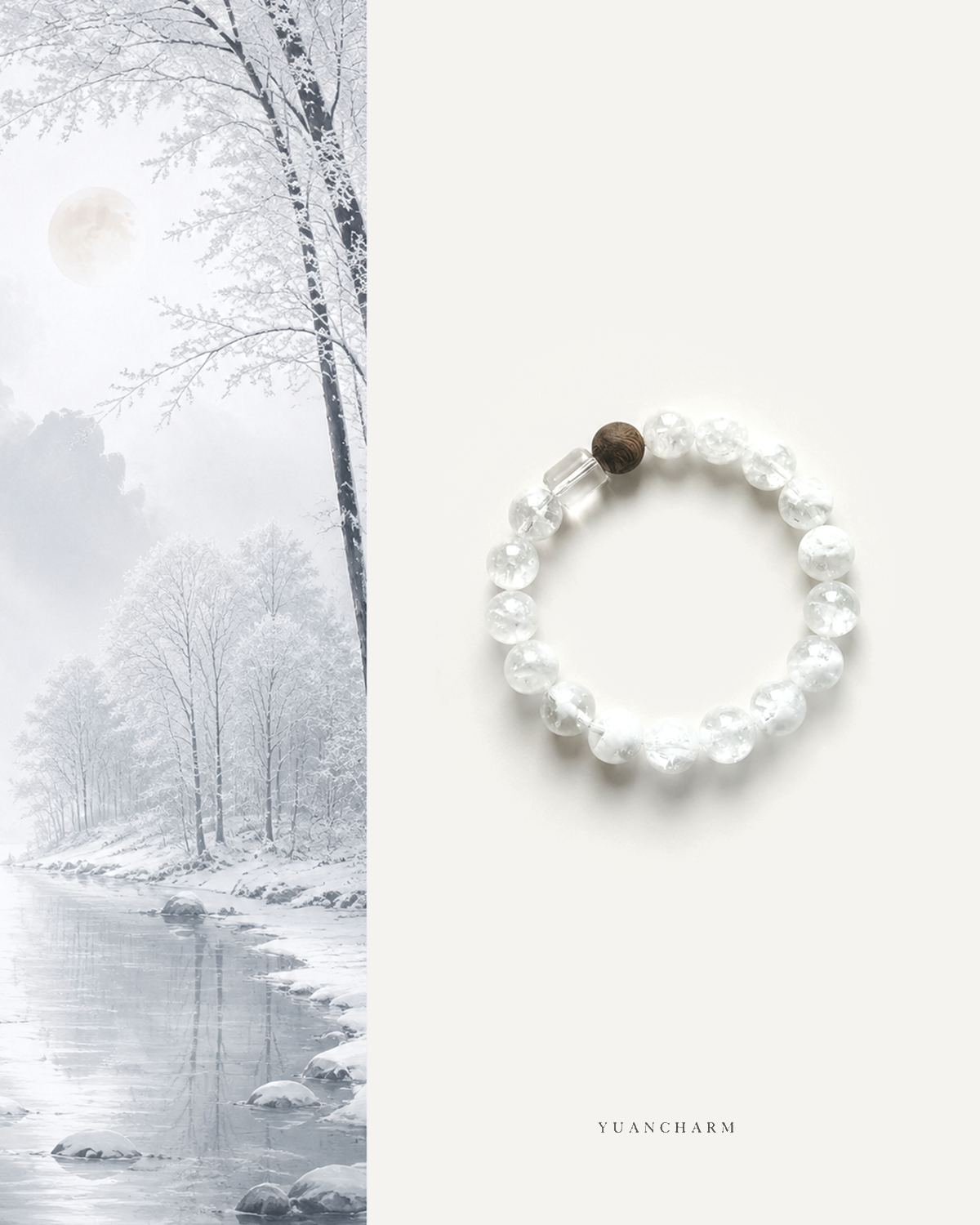
A talisman becomes more personal when it can travel across contexts. Winter Hush uses pale inclusions, clear light, and a warm wood accent in a single-loop silhouette. It can sit beside a soft knit, a dark jacket, or a plain white shirt without demanding a costume around it.
When layering, build contrast slowly. Pair one larger texture with a slimmer, quieter band, and leave small intervals of wrist visible. The space between objects is what lets each object keep its identity. This is the same principle that makes a room, a sentence, or a morning feel composed.
“Personal style is often the record of what you choose to leave out.”
WHEN THE DAY CLOSES
Put the object away as carefully as you put it on.
A closing ritual can be even shorter. Remove the bracelet before sleep, water, exercise, or a task that will expose it to rough contact. Look at it once. Notice whether the carry line still feels useful, or whether the day has changed it. Then store the piece somewhere dry and separate from sharp or heavy objects.
That small act protects more than the bracelet. It creates a clean boundary between what the day required and what you want to keep. Tomorrow, the object can begin again without pretending that today did not happen.
A QUIET DISCLAIMER
A reminder is not a verdict.
The language of ritual can be beautiful, but it should remain honest. A bracelet cannot diagnose, treat, predict, or guarantee. Its value is in attention, memory, and the pleasure of wearing a well-resolved object. If a situation needs medical, financial, or professional support, the right next step is real support.
What jewelry can do is more intimate: it can meet your hand at the moment you remember what you meant to do. That is enough. A small object does not have to promise the universe in order to improve the shape of a day.