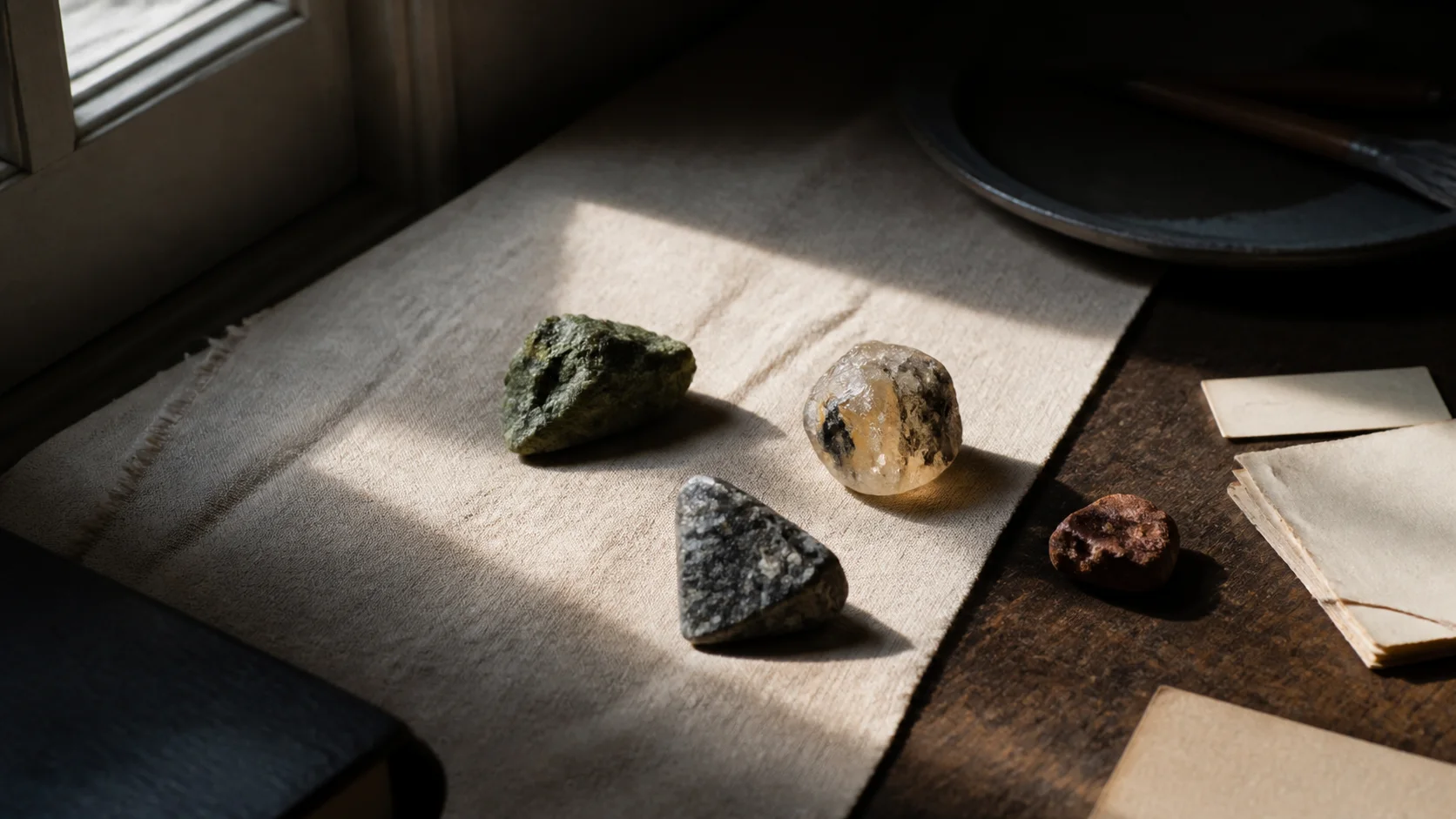
APPEARANCE IS NOT IDENTITY
A stone can be beautiful before you know exactly what it is.
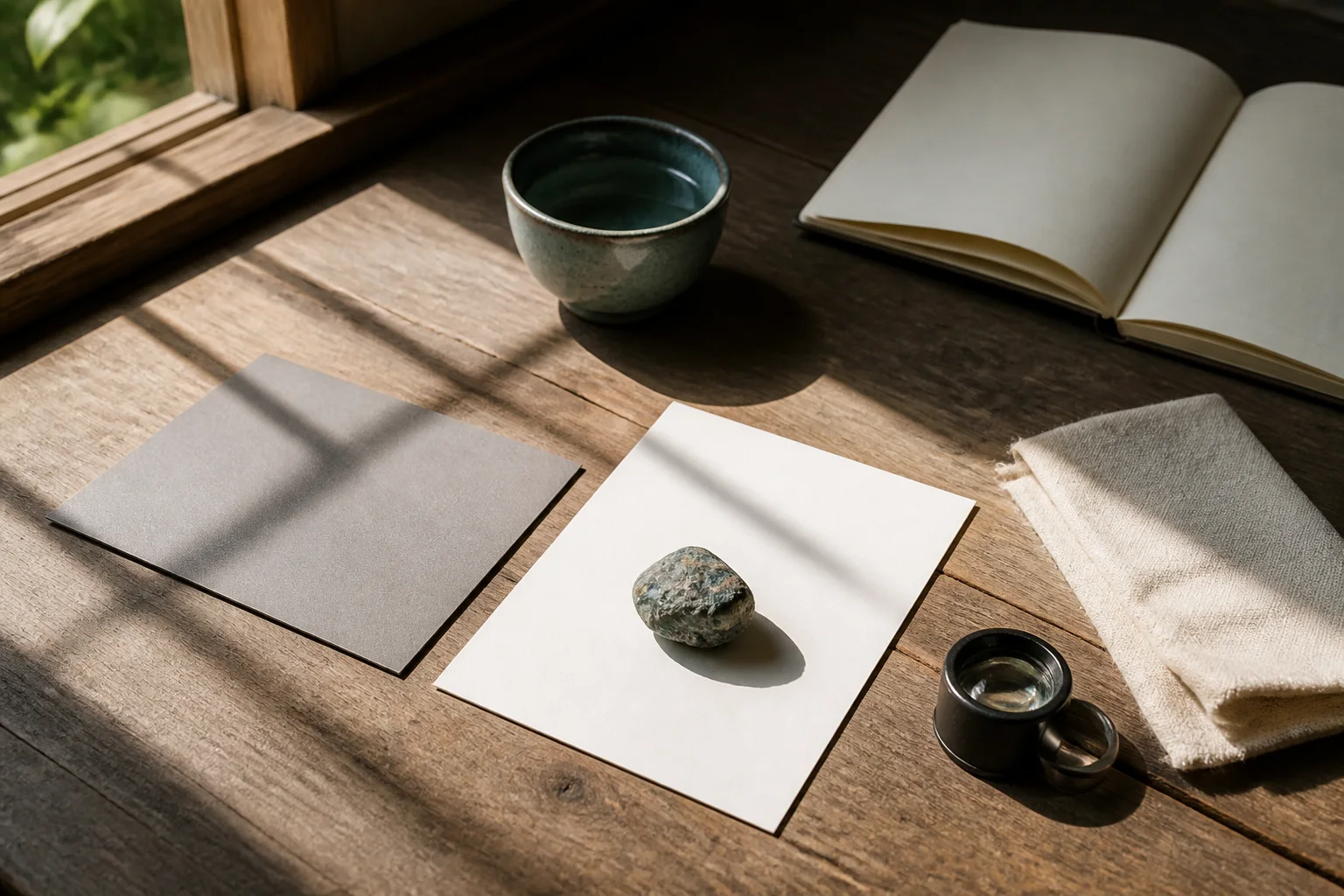
Color is often the first thing we notice, but color is a relationship between material and conditions. Daylight, warm bulbs, a dark background, nearby colors, camera exposure, and the finish of a surface all influence the impression. The same pale blue stone can look grey beside white paper, greener beside wood, and almost silver in a cool window. None of those observations is false. None is sufficient on its own.
This is why a responsible material description separates appearance from identification. You can say that a stone presents a cool blue tone, visible clouding, or a polished surface. A laboratory or gemological claim requires a different kind of support. The habit is useful far beyond jewelry: first describe what you can see, then ask what further evidence would justify the name being used.
“A photograph can show a material’s mood. It cannot carry every fact about the material.”
LIGHT IS A VARIABLE
Before deciding that a stone has changed, repeat the look in a different light.
Place the stone near indirect daylight, then move it away from the window. Look again under a neutral indoor light and a warmer lamp. Notice which qualities stay present: a line, a cloud, a grain, a transparent edge, or a color zone. Notice which qualities appear only in one setting. This is not a laboratory test. It is a way to prevent one dramatic image from becoming an overconfident conclusion.
A useful note has three parts: condition, observation, and question. For example: under cool window light, the surface looks blue-grey and the darker mark remains visible; is the mark a surface feature or an internal inclusion? That sentence is more valuable than a vague claim that the stone has a certain energy. It gives a maker, jeweler, or gemologist something precise to respond to.
INCLUSIONS NEED CONTEXT
An internal feature is a clue to investigate, not a personality test for the stone.
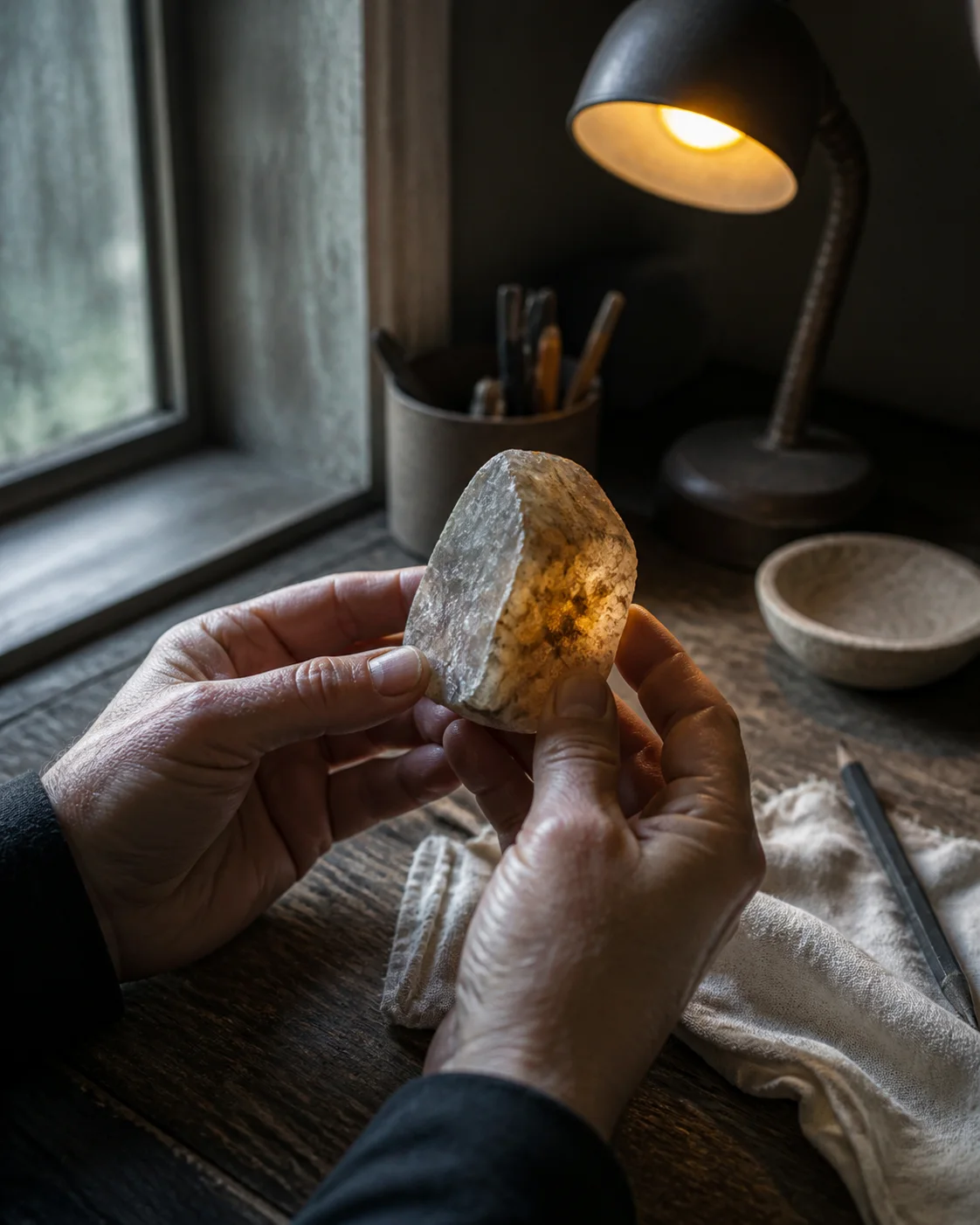
Gemological education uses inclusion to describe internal features such as mineral crystals, needles, fluids, clouds, or cavities. Their effect depends on type, position, quantity, and the host material. Some features interrupt transparency; some create a glow or a line; some are visible only when the stone is rotated. A close photograph can make one inclusion look like the entire story because magnification changes the scale of attention.
Start with ordinary language. Is the detail inside the stone or on the surface? Does it move when the stone turns? Does it catch light, interrupt it, or simply change the color? These observations do not replace professional identification, and they should not be stretched into a guarantee of origin or quality. They do make the next conversation more exact. The goal is not to sound expert. It is to know which question you are asking.
THE FOUR-LOOK CHECK
Use four looks before you attach a story to a surface.
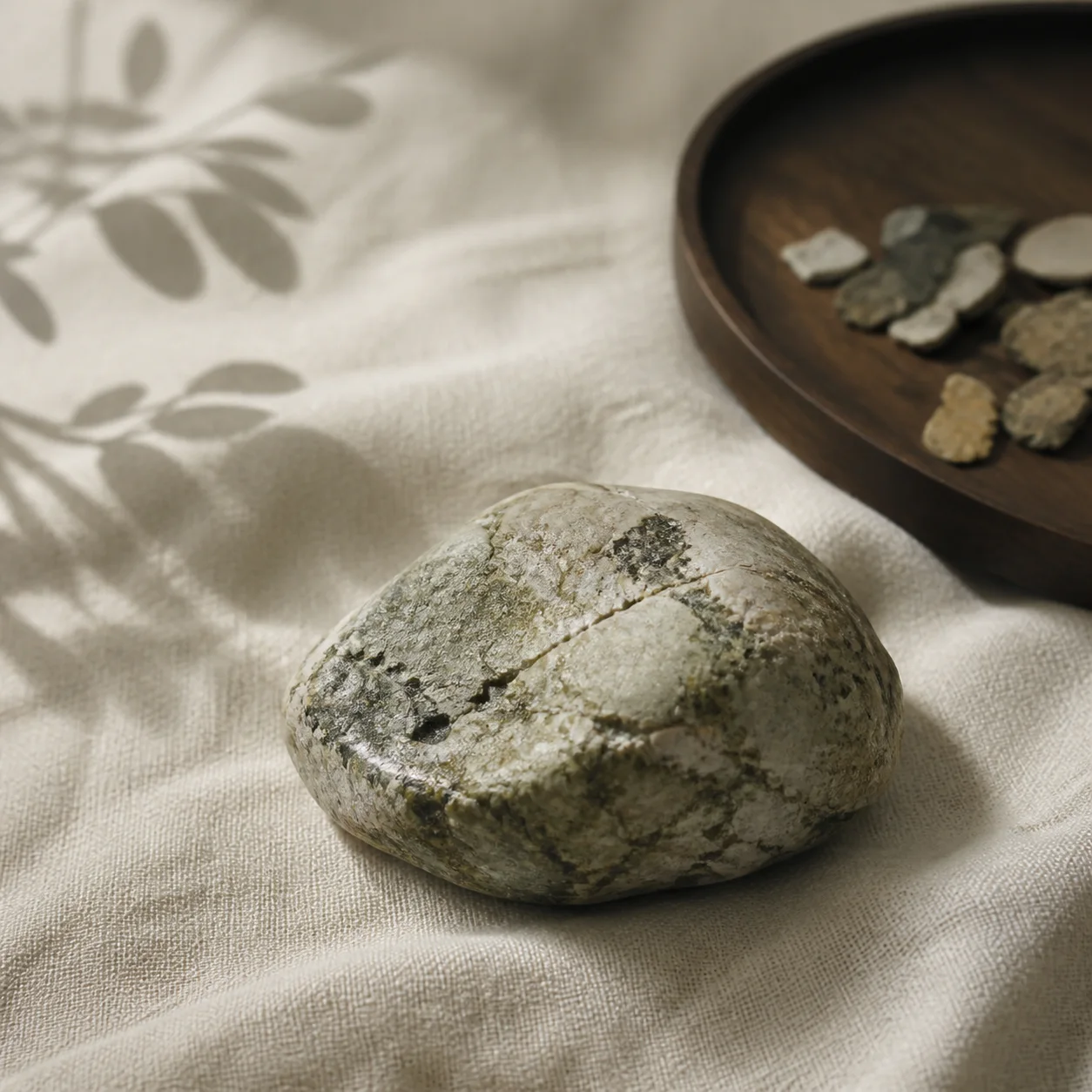
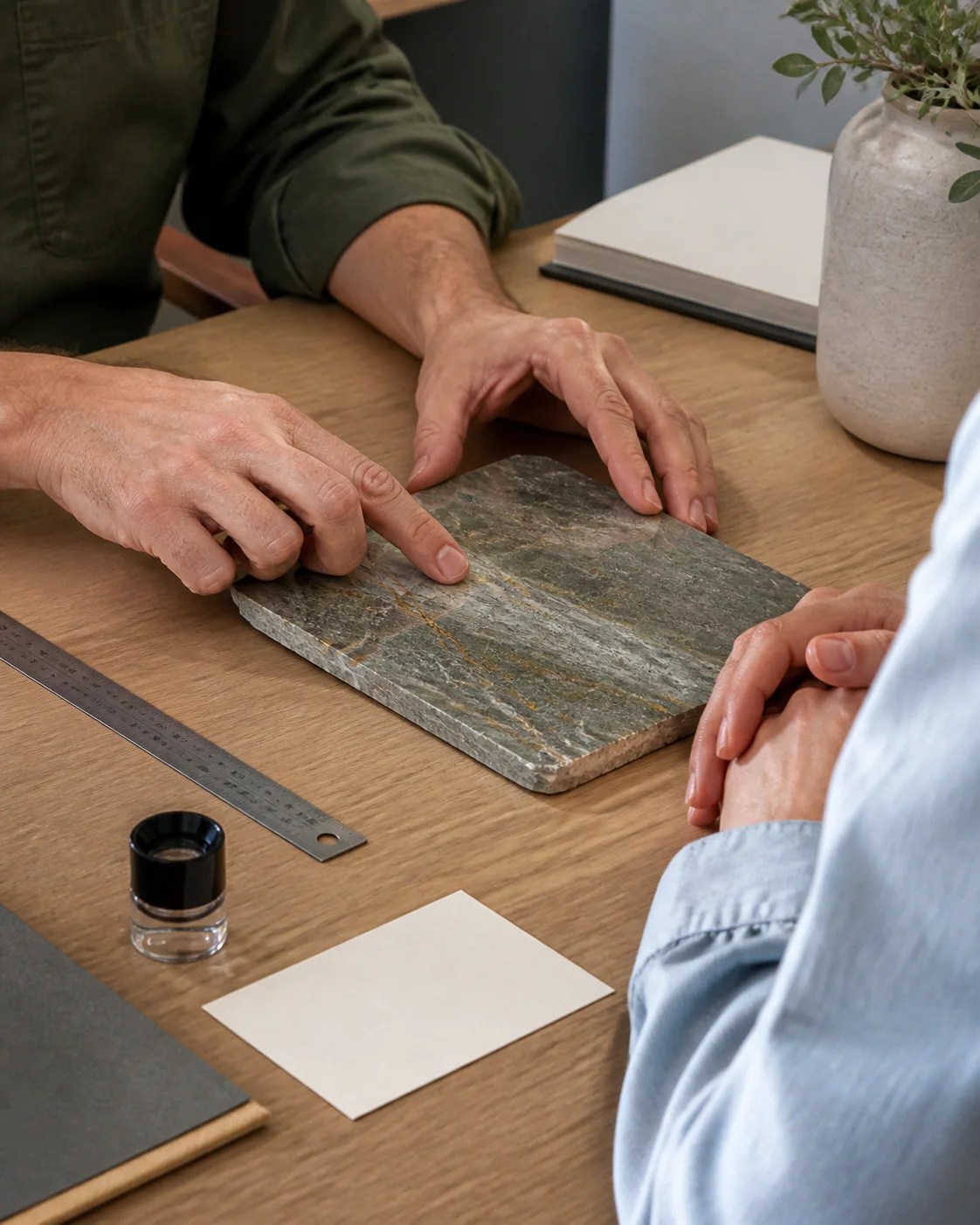
First, look at the whole object from a normal distance. What is the dominant color, scale, and visual weight? Second, look close without magnification. Which detail draws your attention, and is that because of the material or the photograph? Third, rotate it slowly. Does the feature remain stable, disappear, or become a reflection? Fourth, read the product information beside the image. Which facts are described as sourced evidence, which are maker observations, and which are simply an interpretation of mood?
Keep those categories separate when you choose. A natural variation can be part of why you love a piece, even when the exact geological explanation is not available. A treatment can be acceptable when it is disclosed. A generated scene can be beautiful while still being a scene, not a proof photograph. Clear boundaries protect the pleasure of looking because they stop a feeling from having to carry facts it cannot support.
CARE FOLLOWS OBSERVATION
The more carefully you look, the more specific your care becomes.
Care begins with the material actually in front of you. Ask whether it is porous, treated, soft, layered, or vulnerable to heat and chemicals before deciding how to clean it. Keep strong perfume, household chemicals, prolonged water exposure, and rough impact away from any piece unless its care instructions say otherwise. Wipe gently after use and store it separately so the surface can remain legible over time.
The point is not to make a natural material behave like a perfect object. It is to let its real character remain visible without creating avoidable damage. A mark that came with the stone is different from a scratch caused by careless storage. When you can tell those stories apart, you are no longer asking the object to be flawless. You are learning how to live with its actual material life.
CHOOSE THE SEEN DETAIL
Choose the material detail you want to keep noticing, then let the rest stay unclaimed.
Glacial Current is built around this kind of quiet attention: a pale blue single loop, warm agarwood, and a silver-toned detail that lets the cool color remain clear without becoming loud. The design is not presented as a geological verdict. It is a composed meeting of tone, texture, and proportion—something the eye can return to as the light changes through the day.
If the piece speaks to you, name the visible reason in your own words. Maybe it is the coolness beside dark clothing, the warmth of the wood, or the way the line stays calm when the rest of the outfit is moving. That is enough. Material meaning can be personal without pretending to be laboratory evidence. Good looking is not less serious because it leaves room for uncertainty.